Tuesday, June 04, 2024

The Problems in Democracy: Massive Mandates and Coalition Governments


Democracies are considered great forms of government. But, I believe, they have their own shortcomings.

In multi-party democracies like India, for example, a 'massive mandate' for one single party could be a huge problem.   

And so are situations where no single party achieves an absolute majority; that which is needed to form the government. 

A huge mandate of the people shows the great faith reposed by the people in the winning party.  However, this victory,  I think, is not in the best interest of the nation.  The opposition numbers gets drastically reduced and its feeble voice is lost in the majoritarian voices of the parliament 

Also, when a coalition of parties forms the government, it becomes a somewhat unstable government. On its head dangles the Democles' sword, a constant fear, of the loss of the support of the alliance, or some of its members. 

The difference in party ideologies creates an unhealthy relationship - like a forced marriage -  where power-sharing becomes extremely difficult. A very uncomfortable adjustment ensues, and the government will not be as effective as it should be.

Let us have a look at both.

Massive Mandates - Past and Present

The first time I saw the phrase ''historic mandate'' was on the cover of the India Today magazine, when the Indian National Congress Party’s Rajiv Gandhi had had a massive poll mandate in 1984. 

It was soon after his mother Indira Gandhi’s assassination, and the sympathy wave had worked in favour of the party as well as that of the young new politician who soon be the Prime Minister. 

I was very young, but I very distinctly remember seeing the magazine hanging from a bookstore awning. I remember it because of the word ‘mandate’, which was new to me, then.

The Congress party had secured an unprecedented 404 seats of the total 545 seats in the Indian Parliament. A feat that remains, thus far, unemulated, by any party. (For a full list of Indian General elections results, and the party wins, you can click here click here).

In the 1984 general elections, BJP had won only 2 seats. Formed in 1980, as a morphed party from the Bharatiya Jana Sangh (BJS/JS) which had existed from 1951-1977, the new BJP was hardly anywhere on the political horizon then.

But things changed a lot, in the last two or three decades, in its favour. 

Now, with the massive mandate that BJP itself has gotten in 2019, of over 300 seats, it has become the second political party, only after Congress, to secure the highest number of seats in Lok Sabha, the lower house of the Parliament.

In 2024 now, BJP has been aiming for char sau paar or four hundred plus seats. However, by my personal observation of the current political climate, I am sure it is not an attainable number.  

Massive Mandates - The Pitfalls

Whether of Congress then, or of the BJP now, Here’s my opinion: Both 'massive mandates'' have been extremely unhealthy for Indian democracy, 

Massive mandates make the opposition weak.  Bills get passed without adequate debate, and often, with hardly any debate. Opposition benches lose their voice. Their feeble protests will go unheard in the din the majority makes.  Sometimes the bills proposed by the opposition may not even get tabled.

Ruling parties are known to misuse government machinery. 

There would be rampant abuse of power. Take, for example, the India of the recent past. There have been allegations that the supposedly independent bodies such as the Enforcement Directorate (ED), the Central Board of Central Bureau of Investigation (CBI), the Election Commission of India (ECI), and even the Supreme Court, have been doing things under pressure from the ruling party and that they have all not been impartial as independent bodies. 

Instead of being an example for an ombudsman, each body gets relegated to the state of a stooge.  

The ruling party might deny all these accusations, but as they say, sometimes, there is no smoke without fire.

In ‘majoritarian regimes’ – a phrase I hesitantly use – the voice of the minorities is drowned. 

For example, in the parliament today, there’s not a single Muslim MP in the ruling party that is overtly a promoter of Hindutva ideology.

So, where’s the representative form of the government that democracy is supposed to be?

When minorities feel unsafe and feel threatened, it is never good for the country.  

We have seen cases in many countries worldwide, where whole minority communities have been abused because of the second-class status they were assigned. 

The failure of the Fourth Estate

Truth can also be twisted by these majoritarian regimes which often control the mass media. They can buy out communication channels with wide reach, and they can even buy the journalists who do not hold onto ethics as they should. They become propaganda machines and not genuine and impartial outlets for the people’s news and views.

When political parties start using social media channels too, they can spread hate and division. The constant mockery and vilification of the leaders of the parties they are opposed can distort the truth and give rise to many fake news stories. 

I strongly believe that journalists in a democracy should be largely anti-establishment. 

The Fourth Estate should hold the governments accountable. But governments elected by massive mandates can even snub the voice of dissent; the very voice which should be encouraged for the sake of progress.

While we all believe that, in a democracy, the separation of the three branches of the government – the legislative, the executive, and the judiciary – makes the government strong, it is the misuse and abuse of these constructs that have caused the downfall of many a government. Especially governments that have been formed by the massive mandates of the people.


Coalition Governments

I believe that coalition governments are also harmful to multi-party democracies.

When no single party gets the absolute majority to form the government it must make do by accommodating with other parties.

Accommodation is but an adjustment due to discontent. There will be a lot of give and take between the parties that form the government. But all parties are unhappy with the vote share they were able to secure.

Coalition governments are formed on the notion of power-sharing. And with ministerial posts and government positions being allotted based on which party won how many seats, it is mostly confusing.  

Positions get chosen not on the merit of the incumbent candidates but on the mere availability of certain individuals in a party, at that given time. Simply put, these will become governments that have not been striving for an optimum feasible solution but only for a bare minimum adequacy. Accommodation politics can put the entire nation at a disadvantage in the long run. 

The hotchpotch of ideologies, within a coalition, can cause huge discontent during policymaking in the legislature. The seeking of votes for a bill to be passed becomes a necessity for survival, in power, and not an ideological outcome for the benefit of the nation.

And then, there is always that constant threat to the stability of the government. 

The alliance can fall apart at any time. The discontent parties in the political alliance can threaten to withdraw support or might withdraw support; sometimes even for trivial differences.

Coalition Parties post 1947 -  One in Britain, Many in India 

In Britain, David Cameron and Nick Clegg, once political opponents, hailed the creation of the first coalition government since 1945 (or since Churchill's time).

Hinting that "a forced marriage is doomed to fail", about the 2010 Cameron-Clegg coalition, in 'The House'', Sebastian Bale wrote this:

Though subsequent events might have undone the coalition’s legacy, those involved hope history will look back favourably on its key focus: two parties working together in the national interest – a loftier motivation than the power grab critics believe led to its inception. 

It ran the full term. Interestingly, the line, "Political experiment proved surprisingly durable but threatens to devastate Lib Dems" appeared in the Financial Times, just before the elections of 2015, when Cameron's Tory government came to power. This time without a coalition.

While the Cameron-Clegg alliance stayed put, policy-making and nation-building took the secondary place and the government's efficiency was found wanting.

In India, it was in 1977 that the formation of a Janata Party coalition government laid the foundation for the era of coalition politics. 

To defeat Indira Gandhi - who brought upon herself the ire of India for her  Émergency'- other political parties got together, and succeeded.

Since then many coalition governments like NDA and UPA  have all come up but did not do their job as a united alliance.

Numerous cases of power-sharing differences gave way to allegations or charges of corruption on one another that made the governments lose focus on governing effeciency.

Conclusion - what is better? 

Actually, neither the massive mandates for one party (that forms the government), nor a coalition of political parties (that forms the government, but struggles with power-sharing between parties) are good for a democracy. Or, that is what I believe.

A mid-way is always better, with a good winning party and with a strong opposition.

Unlike in Indian democracy where multiple parties vie for power, I believe, the US model, where only two parties - the Democrats and Republicans - fight against one another would be better for a nation's governance.  

Some argue, however, that having ONLY two ideologically different parties is not an answer. But I think it is. 

After all, one should rule, and the other should hold the rulers answerable and accountable.

In Conclusion, while it is hard to always predict the people's mandate, it would be good for a democratic nation if no massive mandates and coalitions are formed. 


Friday, December 08, 2023

Why is Taylor Swift the TIME Person of the Year?

Every year, since 1927, Time magazine names a ‘Person of the Year’, and the world eagerly looks forward to this annual announcement.

As it selects from a longlist of world leaders, social activists, religious and cultural figures, scientists and Nobel Prize winners, there is always a huge speculation on who would be announced.

So, when the singer Taylor Swift was declared the ‘Person of the Year 2023’, it surprised many who never thought, in their ‘wildest dreams’ (it's one of her song titles) that a musician would make it.


She was chosen over other phenomenal 2023 newsmakers whose shortlist included Russian President Vladimir Putin, Chinese President Xi Jinping, King Charles III of UK, Trump prosecutors, Sam Altman, Jerome Powell, Barbie, and Hollywood strikers.

In nearly 100 years, Taylor Swift has become the first ever “musician”, to win this honour.

But why is this singer – who turned 34 on December 13, a week after TIME’s announcement - chosen over several other big names? What makes her special? What reasons justify this choice?

Well, there are many. In October 2023, for instance, she became ’a billionaire’. Her net worth went up to an estimated $1.1 bn.  There are some other musicians whose net-worth is more than hers, but their wealth comes from other investments, and not primarily from music.

According to billboard.com, in just the year 2023, until December 7, she has gotten approximately $1.82 billion in music sales and royalties, concert tickets, merchandise sales at concerts and movie ticket sales!

In her most expansive ‘Eras Tour’, she gave 151 concerts across five continents in just this one year - 2023.  Each of her concerts is said to have had between 50,000 to 75,000 fans attending.

Rollingstone.com said, “Taylor Swift‘s Eras Tour is the highest-grossing concert tour of all time!” It based its data on a live music trade publication, Pollstar, which also declared the tour to be the first ever to gross at least $1 billion.

With this, Taylor Swift dethroned Elton John’s years-long ‘Farewell Yellow Brick Road’ tour for the top spot.  Elton John’s tour had grossed $939 Million with 6 million tickets. But, his tour was a five-year tour. Hers was less than a year.

Even a movie ‘Taylor Swift: The Eras Tour’, that's made on her tour, produced by her and directed by Sam Wrench, has itself grossed $250 million at the global box office.

With her movie, she smashed box office records, mainly by bypassing Hollywood studios and by working directly with the theater chain AMC, with a deal that many musicians did not dare make.

According to TIME magazine, the movie “broke AMC’s single-day advance ticket sales record by bringing in $26 million within 24 hours of the movie going on sale” (TIME, 6 Dec 2023).

This week, by the end of 2023 that is, Taylor Swift has broken Elvis Presley’s long-held record for most weeks spent No 1 on the Billboard album chart as a solo artist, setting a new record of 68 weeks. And she also holds the record for the most albums to debut at No. 1 consecutively, for 13 weeks.

During the Covid-19 lockdown, she released a surprise indie folk album, ‘folklore and evermore’, which was a reflection on social isolation.

In partnership with Google, she recently created online puzzles that revealed track titles of her songs that she put together as a new album ‘from the vault’. While publicizing her songs, this boosted her sales as well as raised her standing in search-engine trends. 

It is clear that her craft, as a songwriter, recording artist, stage performer, image builder, and a business woman, makes her truly deserving of all this global recognition.


Saturday, November 19, 2022

Being the Devil’s Advocate to the Devil’s Advocate

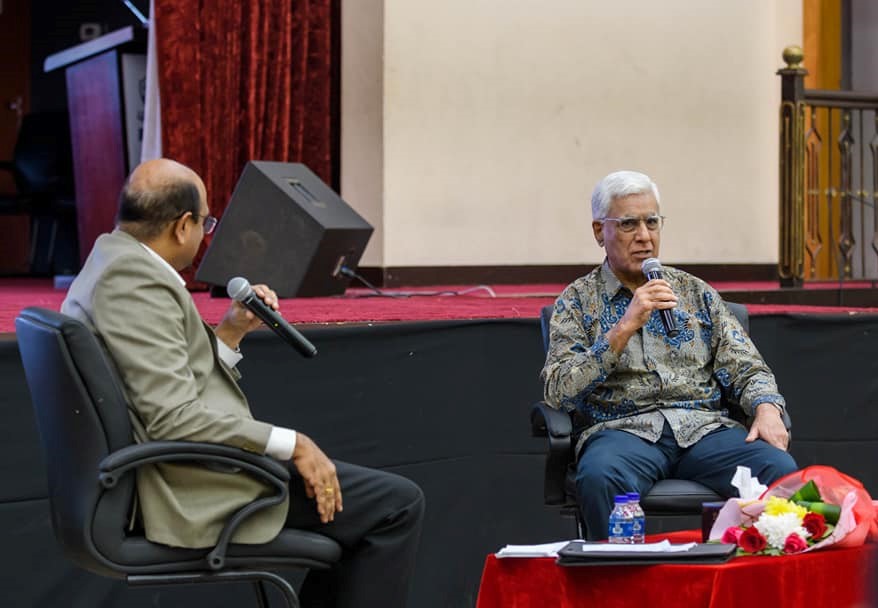
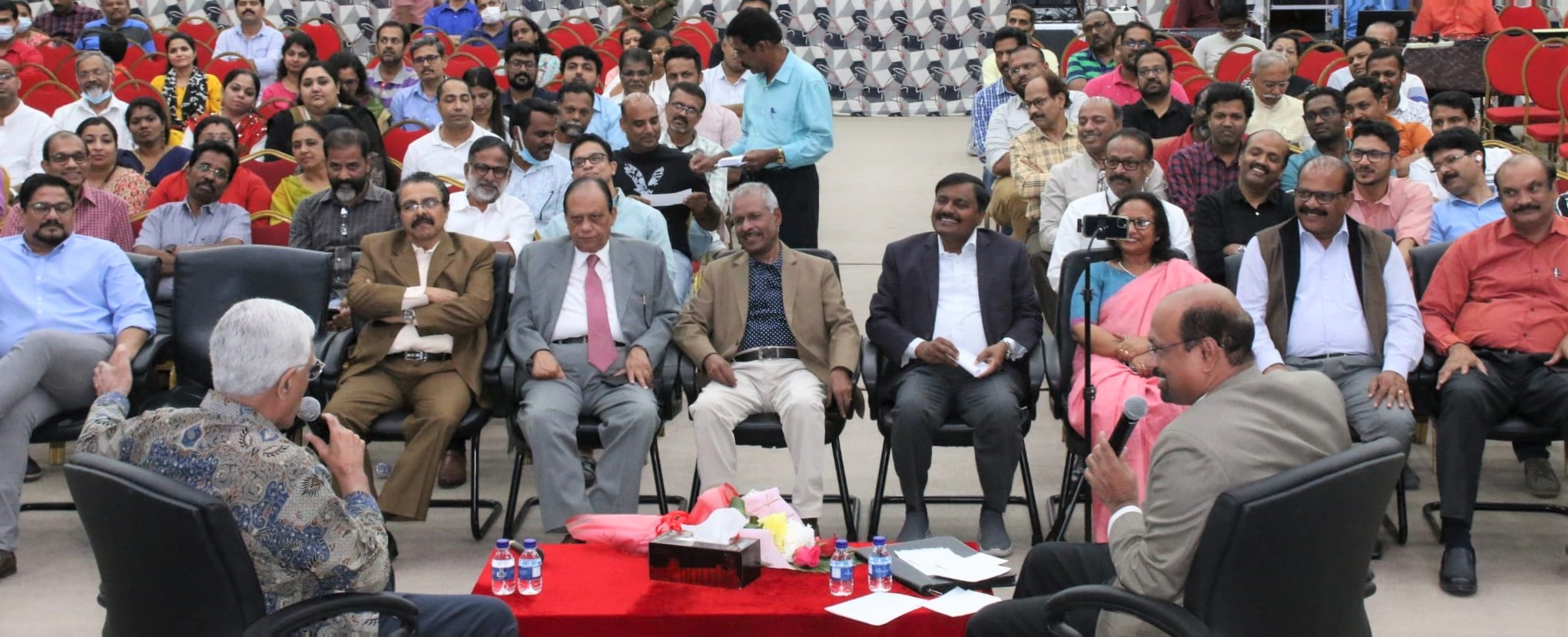
Many of my friends and family wanted to know how my interview with Karan Thapar went, last week. So, I decided to write this blog post for those interested.

Bahrain Keraleeya Samajam (BKS) and DC Books had organized a 10-day Book Fest in Bahrain, for which many eminent writers, poets, and journalists were invited to speak to the audience, on different days. Some in English and some in Malayalam.

On Saturday, 12 November 2022, the renowned Indian journalist Karan Thapar, was here. And I am honoured that the organizers had asked me to conduct this interview -- with one of India's greatest television interviewers.


Before the Interview

As soon as I accepted, I was determined to prepare well. 

In three or four days, I'd completed Karan Thapar's latest book Devil’s Advocate, a biography, which was an amazing source of information for my planned interactive session.  I'd 'listened' to the book on the Audible app. It is my default reading mode these days while driving, or while walking (It was, in fact, this book that had led him here, to the Book Fest).

I heard it well, and I decided I will ask him at least some uncomfortable questions. 

Even, if my questions won't be like the ones he always asks others, I decided I'll still play the Devil’s Advocate, myself, this time.  As much as I can.


12 Nov 2022 - Morning

On the morning of the day of the interview, I texted him saying I wished to talk to him.

He quickly called me himself. And he said he was happy to meet me on phone, and asked me what I would like to talk to him about. 

I said that I'd prepared his short introduction for the audience and I wanted him to see it. And I also said I would like to send him some questions; so that he is aware of my line of interviewing, and what I am planning to ask.

He said, No No No….. Don’t send me anything. Let it all flow free and fair. Ask me whatever you want, and I don't mind you introducing me to them, in any way you wish.


12 Nov 2022 - Evening

After giving his short bio, I started off by telling the audience about a couple of interesting Whatsapp messages I'd gotten some time ago. 

I'd sent messages to my friends, in a couple of WhatsApp groups, telling them I would be interviewing Karan Thapar, on Saturday.  I quickly received two messages from two Indian women in Bahrain, now in their late 50s, saying excitedly that they had a huge crush on our guest speaker, since their college days.

The audience laughed. And our guest speaker looked at me seriously. And he said, please introduce  them to me, if they are in the audience. I said I will.

Not surprisingly, during the interview, our guest Karan Thapar, was very very critical of the current Indian government, and some of its policies. On Indian media, he kept saying that much of it has devolved into ‘godi media', a propaganda machine for the ruling party, bent upon fomenting divisions between Hindus and Muslims. He said majoritarianism is going to become a threat to civil society and to minorities. 

We talked about a lot of things. About Indian Politics and about the changing role of media, in India and abroad.

We talked about Washington Post being owned by Jeff Bezos, in the US, and how, it relates to the Ambanis and Adanis owning media channels, in India

We talked about how much autonomy BBC enjoys - through its charter - even though it is mostly funded by the UK government, 

We talked about the political leanings of Fox News and CNN. We talked about the closure of Rupert Murdoch’s ‘’The News of the World’’ which was a top national tabloid weekly published in the UK from 1843 to 2011

Avoiding portions of controversial Indian Politics, I am writing down below, a few of the other bits, as far as I can remember


-------- ----- -----------------------------

The following conversation-bits are from over a 'one-and-a-half-hour' discussion. 

  1. From my first few questions, the audience came to know that he has ties to Nehru-Gandhi Family.; that his aunt was Vijaylakshmi Pandit’s daughter Nayantara Sehgal (whom he used to call Tara Aunty); and that his own sister, and he himself, were very close to Sanjay Gandhi, as children and teenagers. 
  2. He told us some fun stories of those times, of his growing up.
  3. I asked about his education at the Doon School, then at Cambridge, and later at Oxford, where he had done a three-year research. 
  4. I asked about his first career break, and he told us how – during his time at Oxford - he was approaching newspapers for a job, and how he suddenly got his first job. It was at ‘The Times’, of London, as a foreign correspondent, and how he got posted in Nigeria. 
  5. (In the interview, we did not cover his Ph D, but in his book he mentions that he left Oxford’s St Antony’s, without submitting the thesis, when he found his first job. In my interview he stated he "always wanted to become a journalist, and not an academician").
  6. I asked him about the now-famous interview, from which the then-Chief Minister Modi - and now PM Modi - had walked out. I asked him why he was so rude to a very successful Chief Minister of Gujarat State (which Modi was at that time). 
  7. KT said that it was five years after Godhra, and no good journalist can avoid asking those tough but relevant questions.  He said that the ‘Ghost of Godhra’ was haunting Modi, who like Emperor Nero, looked away when Rome was burning. With these words, KT said he wanted Modi’s reaction, but Modi walked away after barely three and half minutes.
  8. I interrupted and asked – If, supposing, he was interviewing Indira Gandhi, after the mess she created by invoking the law of Emergency – would he have asked the same type of tough questions? In the same rude way? 
  9. He said he would have.
  10. I said, Indira Gandhi was your friend’s mother. A distant relative.
  11. KT said, Even then, I would have definitely asked. 
  12. He said that good journalism means asking fearless questions and holding those in power, accountable. It did not matter if the person is related or not. 
  13. Also, he said he was not rude. He was just forthright, like how journalists should be.
  14. I said, in one of his shows, he accused cricketer Kapil Dev, and made him cry, on camera, and kept taunting him, for much longer than what seemed necessary. 
  15. KT said that he had learned that ‘children laughing and adults crying’ will captivate any television audience. So, when KT confronted Kapil Dev, with the then corruption allegations, Kapil Dev began to cry, when explaining his innocence. And the crying, in a way, KT said was good for his show. 
  16. KT said, if Kapil Dev was crying, why should I stop rolling my cameras? I had gotten what interviewers wanted. 
  17. KT added that he and Kapil Dev have been good friends from that time, and that Kapil Dev had  recently invited him to a big family event of his.
  18. I also said he was a friend of Benazir Bhutto (the former PM of Pakistan, who was assasinated in 2009), when they were students at Cambridge and Oxford. And he was very close to her. Was that not true?
  19. He said yes, and narrated some stories when Benazir Bhutto was the president of Oxford Union, and when he was the President of the Cambridge Union, both Unions noted for their high-powered debates.  He told us how they both first met, and how they had been good friends for years. 
  20. For this friendship, and for another reason - that KT’s forefathers, the Thapars, were from Lahore - isn’t he really a “Pro-Pakistan journalist”?
  21. He angrily asked how I can call him a ‘pro-Pakistan’ journalist.
  22. I said, it was from his articles
  23. He said, show me one article of mine that was pro-Pakistan
  24. I said, I’ll show later, but there was at least one article of his, which Pakistan itself quoted as his support to them. It was on the issue of Kulbushan Jhadav whom Pakistan called an Indian spy
  25. He said no, there was none (later during audience Q&A he said that Pakistan’s stance has nothing to do with him, and that it was some misunderstanding and that he was not culpable)
  26. About the 'Thapars' being from Lahore, he said if my critics think I am a Pakistani because my forefathers were  from Lahore, then Pakistan's President the late Zia-Ul-Haq should've been Indian because Zia-Ul-Haq, himself, was born in Jalandhar in India. 
  27. When I asked about news channels and the stances they take on the political spectrum - from extreme right to centrist to extreme left - he said there is nothing wrong with it.
  28. He said, in the US, Fox News favoring Republicans and CNN the democrats is not really wrong because the public will just get to know all sides. In UK, he added that the Daily Mail was a right-wing tabloid and a tory paper, while The Guardian was a left liberal.
  29. He said that when a wide range of media channels support various stances on the political spectrum, the audience gets to know more perspectives and becomes more educated. 
  30. When I said free and fair journalism is gone, he said, No. Not everywhere.
  31. I said yes, it was, particularly, in India. And he then mentioned that the NDTV, the Wire, Quint, News Laundry and Scroll are all telling the truth better.
  32. I said they are all paid media. Even The Wire, for which he is now working on TV news-show.
  33. He asked, paid by whom. 
  34. I said, ‘paid by Congress Party and its allies’. 
  35. He said that if Congress had money, and if they had given him money, he would not have asked the Bahrain Book Fest organizers for air-tickets; He said he would have had enough money to come to Bahrain, all by himself.
  36. I said he was a secularist, which is a word that’s now being used derogatorily.
  37. KT said, yes, he was. 
  38. He said he was very proudly secular. Just as he is guaranteed that belief, by the constitution. And that it should not be used derogatorily, like how some are doing.
  39. I said he was an elitist.
  40. He said he was sorry if he comes across like that, but that he is down to earth and wants to speak for the masses
  41. I said we cannot trust today's press anyway, or that is what most people say.
  42. He said that we can be sure that with some anti-establishment posture, by good journalists, we can look optimistically at the future of journalism.  
  43. He criticised some sections of the Indian Press that pander to government, as ‘Godi Media’.


Among the questions from the audience were those related to newer revenue models of online newspapers - whether subscription based or advertising funded. There were also questions related to journalistic ethics, education in mass media, independent press, and government control

The media platform he is related to, The Wire, recently retracted its story which had accused Meta of granting an Indian politician special permissions to remove posts on its platforms. There was an audience question related to that.

KT said it does not matter. He said when “discrepancies” emerge in evidence used to back up a story's claims, it is only fair to retract the whole story. He said, unfortunately, some published stories can be found in error. So, withdrawing such material, and letting the readers know the truth, is good journalism.


---

All said and done, I had an enjoyable time. 

During the vote of thanks, the President or BKS, Mr P V Radhakrishna Pillai, asked Karan Thapar how he would rate Joel’s interviewing skills. 

And Karan said, "Very good.  Joel gave me a tough time. And that's what matters. I enjoyed it".

That made my day. 

And even my next day was made, when a Whatsapp message from him, and an e-mail from him, to organizers, appreciating my role, did a lot of good to my ego. :-) 


Thursday, December 02, 2021

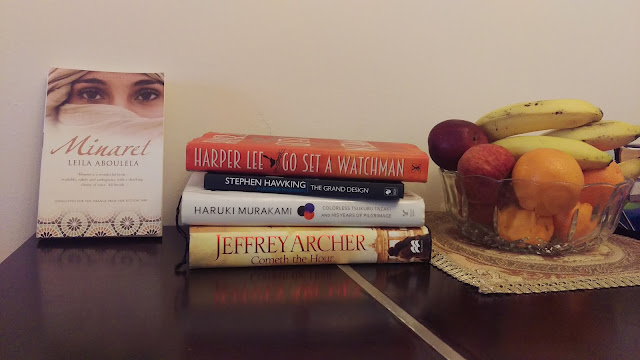
My 2016 Reading - Jul-Dec. Quick Short Reviews

I discovered I had written these reviews, but had not posted these earlier. 

So, here goes.

***


(1) 'Minaret' by Leila Abolulela (fiction), 2004. 

A heart-warming story of a trendy and bubbly young Sudanese girl whose personal life is completely thrown into turmoil, after a political coup in Sudan.  Written in the first person, she tells us how she stoically faces the trauma of her rich-politician father's arrest in Sudan, of her exiled state in London with mother and brother, and of her envy of classmates who become successful --- when she is reduced to work as a maid in rich London homes.

I loved the way the character bares her soul, about her feelings of affection towards a young Sudanese revolutionary, about her handling of jealousy and betrayal,  and about her most important choice ahead. Can she be a true Muslim?

This novel was in the running for the Orange Prize and the IMPAC Dublin Award. And I am glad I bought it at Bahrain Airport in September. I give it three-and-half stars.


***


(2) 'Go Set a Watchman' by Harper Lee (fiction), 2015.

I‘d enjoyed her prequel 'To Kill a Mocking Bird'. Twice. Once, as a reader of the book, and once as a listener to the audio Book. And, on both occasions, I had become completely immersed in the happenings of Maycomb County, and in its people. Therefore, I was glad to have received this sequel, as Birthday gift last year (Thank you, Preeti Borde!). The setting of this book is twenty years after the earlier book. And we see the now-grown-up Scott Finch battling with her father Atticus, against his values which seem to have changed  (The character Atticus Finch, btw, is right on top of the ‘greatest cinema heroes’ according to American Film Institute. Beating the likes of James Bond, Indian Jones, Rocky Balboa, Han Solo,  Superman and Tarzan. Go on. Google the name!)  

I must say this book was a bit of a let-down. It may be of great value, due to the exceptional literary skill of the author. But when compared to her earlier book. Sorry. Not up to the mark. I give it only an overall rating of three stars.

***


(3) 'The Grand Design' by Stephen Hawking & Leonard Mlodinow (Science), 2010.

A well-done treatise on the history of scientific knowledge, over centuries. From stories like those of Skoll and Hati, the wolves, which cause  eclipses, in Viking mythology (comparable to Rahu and Ketu, the demons, in Hindu Mythology) to the latest analysis of the Theory of Everything and M-theory, the book traverses a path that is bound to be 'fun reading' at times, and ‘extremely difficult’ at times. Especially, if you are not a reader inclined towards Science. 

During my B.Sc or University days, one of the prescribed books for my third year was J B Rajam's 'Atomic Physics'. The extreme labour to which our Physics lecturer had subjected us, has finally paid off! Thanks to him, I am now able to grasp at least some of this book's mind-bending explanations. As topics like String Theory or M Theory were non-existent in our text books then, it was hard to follow these new theories on quantum mechanics. But, the authors tried to make it as simple as possible to make us understand, well, 'The Theory of Everything'!

Last two chapters went over my head, but the summary of my learning is this: The Origin of Universe (they actually use the term 'Multiverse') does not require God. There is, apparently, a Grand Design. But there is no consistent scientific model to explain the origins effectively, or to show us a designer. Okay, I am giving the book Four Stars. Just to sound erudite ;-)

***

(4) 'Colorless Tsukuru Tazaki and His Years of Pilgrimage' by Haruki Murakami, 2013.

What do you do when all four of your best friends’ have a colour’s name in each of their names, and you don’t? You could feel colourless; and even develop an inferiority complex. And what do you do when four of them (two girls and two boys) suddenly banish you from that wonderful five-member-high-school-group which you’d enjoyed being a part of? And when they refuse to even tell you why?

You can get suicidal. And Tsukuru Tazaki contemplates suicide. But, yet, struggles and tries to move on. But is continuously depressed.  Until, many years later, a girlfriend persuades him to go and confront the ghosts from his past.

Now, as he goes back to his friends, who are now with spouses and kids, the mystery of his banishment starts to unravel. 

The book builds up the suspense and tension, and the struggles, very effectively. But, somehow, personally, I felt the book became a bit disappointing, towards the end.

It is my first reading of a novel by Murakami. But it is the successful writer's thirteenth novel. I did not like this book much (But I am told that I should not miss his ‘Norwegian Wood’. I hope to get a copy soon).

He may be a successful writer. But for this book, I’ll give three stars.


(5) ‘Cometh the Hour’ by Jeffrey Archer (fiction), 2016

The sixth book of ‘The Clifton Chronicles’, the penultimate one kept me in its grip from the beginning to the end, like the five books in the series, earlier. 

As the story of the Barringtons and Cliftons, which began in 1920 in the first book, moved into the 21st century, it had all the twists and turns, surprises and shocks, that you'll find in all his books. 

Indian friends might like the character called 'Priya', and the minor references to Indira Gandhi and Rabindranath Tagore.  

I feel the author knows, for sure, that he has a huge Indian readership. . and he catered to the segment well.  Three-and-a-half stars.


***

Thursday, November 12, 2020

The Maker of Manama-hattan

"What if I don't like the place? What if I want to return to India after 6 months"? I asked my prospective employers.

I was signing a two-year contract to work in Bahrain. And like many people at that time, I was not sure how the country, and its people, would be.


In fact, I clearly remember reading the name of HRH the Prime Minister Prince Khalifa bin Salman Al Khalifa’s name then, when I checked a volume of Britannica Encyclopaedia under ‘Bahrain’, in a British Library of my hometown.

World wide web was still very very new then, and Yahoo’s search engine did not return much information on Bahrain. I remember the name because I had found the repetition of 'Khalifa’ in the late prime minister’s name twice, somewhat strange.

Willing to risk 6 months, I came to Bahrain. But those ‘6 months’ turned into ‘22 years’ this month.

NBB (National Bank of Bahrain) building was the tallest building in Bahrain I had seen when, after I was received, I was being driven from the airport to my company accommodation. 

Today, I see not one tall building, but many skyscrapers. A full ‘Manama-hattan’ skyline.


All, thanks to the dynamic visionary leadership of this great man who left us now. It is not just the skyline, but the economy and the human development index which have all risen higher too.

The wise leadership, and the determination with which he motivated his council of ministers to work for the betterment of the country will be deeply missed.

If one is bewitched by beautiful Bahrain, it is because of great governance by the ruling family, and especially, by the late Prime Minister. He leaves behind a huge void which cannot easily be filled.

His was a leadership which made Bahrain strong and vibrant for all citizens, and which made Bahrain welcoming and safe for all expatriates.


Wednesday, September 16, 2020

To be or not to be on Social Media. Is that still a question?

It is the best thing I watched this week. Or, that's what I think.

'The Social Dilemma' on Netflix.


It is a powerful documentary that shakes us up, and wakes us up, to the shocking reality of Social Media, and how the use of Artificial Intelligence and Machine Learning can unfavourably affect us.

If it has not already affected us, that is.

It is a strange irony that I am sharing this 'anti-Facebook and anti-social media' post on a social media networking site. But therein also lies the answer. At least, partly.

The problem is not ‘technology’. But how it is being designed and manipulated so that the advertisers get their due; and so that the investors get what they want - from these giant tech companies they funded.

But, are we even trying to understand, at what cost to human psychology?

And at what cost to the democratic societies, which are becoming more and more divisive, thanks to the often-dubious posts that get shared and re-shared online? Sometimes a million times in a few minutes.

With fake news, rumours, and misinformation, spreading "six times faster than facts", with AI "getting better and better at predicting what keeps us on the screen", at an individual level, "we'll probably destroy our civilization with willful ignorance". Unless we change the way, it is run.

But "how do you wake up from the matrix, when you do not know that you are in the matrix"?

"Is it some kind of simultaneous utopia and dystopia"?

Can we really put "the genie back in the bottle"?

"Maybe a data-tax would prevent companies from acquiring and storing every piece of data on their customers' or users' online behaviour".

These sentences and phrases above, within quotation marks, are just a few of the many thoughts I had heard various people say, in the documentary.

And who are these people?

Most of them are former engineers and executives of Facebook, Google, YouTube, Twitter, Pinterest….

… who now realize that tech design should become 'more humane'.

I liked the way the docudrama (I think it is a better word for the show, than documentary) was able to follow a small family, with its key characters struggling to come to terms with their addictions to mobile phones and social media.

I felt however that the climax of this somewhat subliminal story could have been written better.

The best thing, however, is the way – despite the number of individuals giving opinions - how the opinions were all crisply edited to keep us engaged and excited. Awed and Amazed. Perhaps, more appropriately, shocked and stunned.

Thankfully, it is not all doom and gloom. It is not like some strange end-time prophecy. But it hovers somewhere close to that description.

There were some answers to the problem facing us.

But I wished there were more.

It is a must-watch. If you really want to learn about the edge of the precipice, towards which these 'social media networks' are leading us all.

I am giving it four stars, out of five.

★★★★☆

Trailer Below.

---------------------------------

I had written some stuff, on these issues, in my weekly column 'Wide Angle', in Bahrain’s 'The Daily Tribune' earlier.

And I am sharing a couple of links below to the blog where I have them.

Are filter bubbles isolating us intellectually?

What's the New Weapon of Mass Misinformation?

Saturday, June 06, 2020

Rodney King, George Floyd, and the Visual Media

About 29 years ago, for us, young people in India, a weekly television news program called 'The World This Week', was the only window to the outside world.

Of course, for us then, listening to BBC news on short-wave radio was possible. But ‘watching news’ was still a new thing. And it was very different, and more interesting, than listening to the radio or reading the newspapers.

It was in this program that I clearly remember ‘watching’ the video of police brutality on Rodney King.

It was probably the first-ever amateur videotape leaked to TV News, in the USA. And the first violent video that must have gone ‘viral’ – on TV News - long before the term ‘viral’ for videos got coined.

I remember the veteran Indian newscaster Prannoy Roy telling us how this footage was taken to a US TV station, from where several cable news networks had picked it up. And how it had spread like wildfire then.

When camcorders or handy cams were still very new in the market, this recording of violence in the USA, against a black man, had shocked and infuriated people.

We had come to know later that Rodney King was an ex-convict, on parole, who was chased by police, for speeding and was brutally beaten.

But whatever King’s legal status was, the brute force itself, led to a huge outcry. Some had counted 33 baton strikes on a completely unarmed man.

Moreover, all hell broke loose when those four police officers, on trial for hitting King, were acquitted.

The news had immediately caused huge riots, arson and looting in Los Angeles.

About those 1992 Los Angeles Riots, Wikipedia tells me this: “The complete disorder in the Los Angeles area was only resolved after the California Army National Guard, the United States military, and several federal law enforcement agencies intervened.

“By the time the riots ended, 63 people had been killed, 2,383 people had been injured, more than 12,000 had been arrested, and estimates of property damage were over $1 billion”.

It was then that the ‘Insurrection Act’ was used, for the last time, in the USA. And according to some legal experts, invoking this Act once again could completely undo all these years of police reform.

Let us flash forward, now, to these last ten days in May-June 2020. We have seen the death of George Floyd, or what had happened just before his death. It was also caught on camera.

In fact, it was caught by not one, but many cameras. Some cell phone cams, and some CC TV ones.

In them, we have seen a grown man cry out for his mother in utter helplessness. We have seen him ask for water and say he cannot breathe, again and again. But the knee on his neck didn't let him breathe.

Between that Rodney King's time and this George Floyd's time, a lot of water has flown under the bridge. Things have changed a lot. Some for the better. Some for worse. Racism may have declined. But apparently, it is not all gone.

But let us admit it. If we had not seen the video, we would not have believed it. We would not have been shaken, or stirred, emotionally like how millions are today.

We must acknowledge that visual evidence is a critical component of truth. It is not easy for us to understand and believe some events unless we see the visuals. Very often, visual imagery exudes a strange power. An inexplicable influence. The old maxim of ‘seeing is believing’ clearly holds water.

The visuals of the George Floyd Protests too, whether they are of mobs looting stores, or of policemen shoving down old protestors,  can provoke us to various emotions.

Depending on which side of the fence we are, we could get angry at the other side.

Today’s ubiquity of visual recording devices tells us something interesting. That the Orwellian imagination of a dystopian age - of a big brother watching us - has mutated, into something different today.

Not only into continuous government surveillance, if the government so decides, but also into the availability of numerous independent recordings, in different versions, that can be checked, rechecked, and used to verify the facts.

Sometimes, depending on the perspective, the angle of the camera, and the one who'd shot it, we can get at least a good segment of truth; even if not all truth in all its entirety.

The power of the visuals is something we definitely cannot avoid now. Our TVs, laptops, tablets and mobile phones, coupled with broadband and cloud, are giving us enormous power to record, store and retrieve them in ways that were hitherto impossible.

With the number of cameras become larger and larger, and with the broadband becoming broader and broader, the visual data is sure to become more and more. And the future generations will have to wade through gazillions of pixels to find out what they want.

According to YouTube statistics, people watch "One billion hours watched daily"!! And I am sure it will keep increasing.

Whether we must be thankful for the availability of many recording devices all around, or whether we should be upset that they are causing needless paranoia could be a matter for debate.

But without a doubt, the footage from millions of cameras could be a nemesis to some.

Especially to those on the wrong side of the law.

Wednesday, April 15, 2020

Video Conferencing and Data Security

“Zoom, the video conferencing app that has become wildly popular during the coronavirus crisis admitted that it had “mistakenly” routed some user data through China.”

This news item in the Financial Times of 4 April 2020 said that Zoom “had ‘mistakenly’ allowed the calls to flow through its two Chinese data centres since February as part of its efforts to cope with increased traffic, as millions of users flocked to use its technology to host business meetings and social catch-ups during lockdown.

“The company said it had since fixed the flaw, adding that the error occurred only “under extremely limited circumstances” and that government customers were not affected”.


As Zoom is based in California’s Silicon Valley, the government it refers to is the US government.

But, what is wrong if its user data had flowed through two Chinese data centres?

Simple. It creates strong suspicions, and fears, that Beijing could be spying on all that data. The Chinese privacy laws could demand that those companies with data centres in China should necessarily share data with the Chinese government when required.

These same security concerns are among the top reasons why Huawei is unable to roll out its 5G plan, globally, as quickly as it wants; especially in the USA.

China’s Huawei is the world's No. 1 telecom supplier and No. 2 phone manufacturer. But the latest news is that Huawei is not allowed to roll out its 5G Plan in the UK too.

One of the biggest concerns for the future is ‘data security’ today. And unless companies make appropriate strategies to protect their consumers’ data, we will be diving into a big-brotherly world where individuals would have to fear the abuse and misuse of their privacy.

We have heard of how Facebook and Cambridge Analytica together misused individual users’ privacy.  We have heard of how Apple’s iCloud data-breach put up thousands of intimate and private pictures of celebrities out in the public domain. We have heard of how some governments’ data centres - of millions of utility accounts of citizens - were hacked by cybercriminals who put up some of the personal user data online. We have heard of the Wiki Leaks!

Take an interesting case from India. It is being alleged that India’s defence minister had recently used Zoom Conferencing tools to discuss with the Chief of Defence Staff, a few days ago.

India and China are both nuclear powers, and neighbours, who do not see eye to eye on some national borders which are disputed.

So, with Citizen Lab, a Canada-based independent research organisation, finding out that Chinese servers are being used to distribute encryption and decryption keys for video links on Zoom, there are new apprehensions on India’s defence security too.

In today’s COVID 19 global scenario, there is a huge surge in demand for video conferencing tools.

Zoom’s usage alone went up 20 times! It had announced on 1 April 2020 that “as of the end of December last year, the maximum number of daily meeting participants, both free and paid, conducted on Zoom was approximately 10 million. In March this year, we reached more than 200 million daily meeting participants, both free and paid” ( for their statement click here).

Apart from Zoom, there are several other videoconferencing tools like Microsoft Teams, Microsoft Skype, Google Hangouts, Cisco Webex Meetings and GoToMeeting which have all seen an enormous surge in usage in just the last three months.

They are being used not only for office meetings but also for holding online webinars and conferences as well as for virtual get-togethers of family and friends.

And we must, therefore, hold accountable all software companies to ensure that our user data is well protected.

Wednesday, April 01, 2020

Social Distancing - A Misnomer?


“Not enough storage space.”

That’s my phone speaking to me.

When I try to click a picture, it says, “Clear some space and try again”.  And it’s been telling me this, again and again, since yesterday evening.

Inundated with a million messages, bombarded by a billion buddies, my phone memory must be bursting at the seams; or bursting at whatever the chip’s corners are called, these days, in scientific parlance.

Well-intentioned relatives want me to know how this COVID 19 spreads. Well-informed acquaintances want me to try to ‘flatten the curve’. Well-wishing friends want me to cheer up, and smile in these difficult times.

So, from jokes to memes, from parody songs to comedy quotes, from a thousand suggestions to prevent COVID 19, to a hundred medications to fight the outbreak, I keep getting new messages faster than I could delete the old ones.

Those afflicted with this raging new malady, of social sharing on telecom networks, are probably simply taking revenge. Maybe their phone memory chips are getting filled, and they are quickly passing its content on to others. Maybe their fingers are just wandering about on keyboards that are not 'locked down’.

Which brings me to the key issue I wish to address, in this column today – social distancing.

Is it really the right term?  Does it really mean what it does?

This has been bothering me. And, I am sure, it must have been bothering many other like-minded victims suffering from an acute shortage of phone-memory. And others too.

Tell me, can we ‘really’ keep 'social distance'?

We must admit, we are unable to distance ourselves from all those contacts who are tracing us; and forwarding us those audio-video clips, and those gif-jpeg images.

I am socially connected to all my friends. Almost always. Even though one is staying farthest, near the North Pole in Norway, and one is sailing on a ship to a station in Antarctica, I cannot distance myself from either of them.

On social media, I get to see their posts on whether polar bears or penguins have any chance of getting affected by a mutant coronavirus strain. Will it get passed on from humans living in those parts. On their WhatsApp messages, I see their thoughts within seconds. In fact, in real-time, I see if ‘they are typing’ now.

So, shouldn’t the term be ‘physical distancing’ actually?

I seriously think, like many others, that the correct term to use these days is ‘physical distancing’ and not ‘social distancing’.

Language-challenged lexicographers may be rare, but there is no shortage of verbally-confused world leaders. So, we all, like sheep, have gone astray; and are readily calling a spade a shovel.

We all know that vegetarians eat vegetables. But do humanitarians eat humans?

No. That's a case in point, to show how we often deny distinguishing the terms. And grow and accept their usage, over time.

‘Man is by nature a social animal’, said Aristotle some 2400 years ago.

But what would Aristotle call man today, seeing that man is now endowed with enormous power; thanks to a palm-top device, with social media apps, that gives him global connectivity?

Communicating with his fellow beings is something man is unlikely to stop; mainly because physical proximity is no longer an impediment with today’s technology.

It is that innate social connectivity that a man desires which makes 'solitary confinement' in jails such a dreaded punishment.


Thanks to social media, the term 'posts going 'viral’' is now clearly understood by today’s generation.

But then, 'fear' and 'happiness' are both contagious too. And social media communication can make them go viral as well.

To stop the real virus-spread, physical distancing is needed. But to stop the ‘fear’, perhaps, social distancing is needed. But then, think again. We need not distance ourselves, socially, if we want to spread ‘happiness’. In fact, social closeness can spread happiness faster.

So, if you see me sending you forwards, please excuse me.

Maybe I just contracted one of these novel network-bourne ailments.

And, hopefully, it's the better one.

Wednesday, January 02, 2019

A Medical Pioneer: The Legacy of Dr Samuel Zwemer


Dr Samuel Zwemer got out of his ship, landing on Bahrain's shores, on 7 December 1892.

For this missionary-doctor from the USA, Bahrain had already been a port of transit, on a couple of earlier occasions.

Travelling to and from Basra, in Iraq, during his stop-overs, he was enamoured by the beauty of this land, and its people. So much so that, this time, he decided to stay on and see how he could be of service.

Thanks to the welcoming nature of the people of Manama (he used to spell it as 'Menameh', in his journals), to the beautiful walks he had had in the date-palm gardens here, and to his soon-developed friendship with a Goan postmaster Gunsalves, he made up his mind. 

He found a room to rent, in the bustling souq area, beside a mosque.

Then, by establishing a little dispensary and a book-shop, Dr. Zwemer distributed books and medicines, and treated people who came to him with medical problems.

It is hardly surprising that, within days, the number of patients who visited this man, who was fluent in Arabic, had increased, by many folds. By February 1893, he had recorded in his journal that over 200 people had already received medicines from him.

The number of patients needing medical care increased daily, and some patients were soon coming, on boats, from the eastern province of Saudi Arabia. They had heard about a doctor and a clinic in Bahrain.

Needless to say, more doctors, nurses, teachers, and their families were needed, and they soon joined Dr Samuel Zwemer.  

And thus, from this dispensary, was born the 'American Mission Hospital'.

n 1899, with the growing need for a school, for the hospital staff’s children, his wife Amy Zwemer, started what she called ‘The Acorn School’. It had recruited even craftsmen from Bahrain to teach children many useful crafts.

Mighty oaks do grow from little acorns. 

For, from this school was born the ‘American Mission School’, which became the ‘Al Raja School’. 

And it has been consistently producing some exemplary leaders for this country.

In fact, it is my meeting with Mr Gary Brown from USA, the former principal of Al Raja School, which actually spurred me into writing this particular piece, in this column.

Three weeks ago, I had the special privilege of learning from him, and from another veteran from India, Mr B M Gorde, some amazing facts.

The 90-year old Mr Gorde, who came to Bahrain in 1964, is the oldest member of the National Evangelical Church which has always been associated with both, the hospital and the school.

Mr Brown said that the Bahrain of 1970 - the year he landed here - was a lot different from the Bahrain of 2018 that we see today. Americans like him had to speak in Arabic because not many parents of his school children could speak English then, like they can do today.

Even though he is retired, Mr Brown is now back in Bahrain, and is currently working on a book on the alumni of the Al Raja School.

Old students of the American Mission School (Al Raja School) who are interested in contacting him can write to alumni@alrajabahrain.org.

But let us come back to our missionary Dr Samuel Zwemer. I find it pertinent to mention here that the bookshop he had opened became known, later, as the “Family Bookshop’.

Sadly, it is no longer in existence, even though it was the hub of all book lovers in Manama, until as recently as the year 2005.

The legacy of Dr Samuel Zwemer in this beautiful Kingdom of Bahrain will live on, in many ways.  

And one way it will live on - one proof of his pioneering work - will be through a postal address. 

The hospital, school and church still receive letters at: P O Box 1.

Saturday, November 17, 2018

Bhavahara: A Creative Dance Ballet


Watching ‘Bhavahara’, the innovative experimental dance ballet, organized by the Indian Institute of Performing Arts, was an enjoyable and uplifting experience.

It's hard to believe that all the dancers and actors of this dazzling performance - held at the Cultural Hall in Manama yesterday - are those living in Bahrain, and not professionals brought into the country. And all these amateurs' hard work of months of rehearsals yielded a mesmerizing spectacle of dance and music.

The event was in two parts - Saama Gaana, a music concert and  Bhavahara, the dance ballet.

Pleasing Carnatic Music - by the renowned singer P Unnikrishnan - as a part of the concert, aptly set the stage for the ballet.

The vocalist, who flew in from India, regaled the audience with a few Tyagaraja kritis, and other compositions, effectively energizing everyone; especially those from Telugu, Tamil and Malayalam backgrounds.

I felt the recital’s duration was just enough for the audience, to appreciate this form of classical music from South India. And not long enough to make anyone impatient, in case they were waiting solely for the dance ballet.


He was accompanied on the violin by Jaydevan, and on the mridangam by Neyvelli Venkatesh, both of whom, by the end, proved they were stalwarts in their own rights.

In a pleasant surprise, I learnt on Friday night that P Unnikrishnan was the same playback singer who had sung one of my favourite Telugu film songs, ‘O cheliya naa priya sakhiya’, and its original Tamil version.

Therefore, on public demand, despite its slight incongruity relative to the concert's classical focus, he treated us to his Tamil version, ‘Ennavale Adi Ennavale Enthan Idhayathai Tholaithu Vitten’ from the movie Kaadhalan.

[Somehow I’d never liked the movie’s computer graphics in that particular song (the movie was called 'Premikudu' in Telugu)  shot on the lead actors Prabhu Deva and Nagma. I’d always felt that the silly graphics did not match the classical nature of that soulful number. And I still feel the same. Strongly. But that is beside the point].

Coming to the ballet ‘Bhavahara’, I must say, it was a visual and aural delight. It was a spectacular show that uplifted the spirits of the audience. It did not matter if the audience was aware of the Hindu epic Mahabharata, or of those particular scenes from which this ballet drew. It just touched the senses aesthetically, and emotionally.

Whether it was the introductory scene of Kunti’s mental turmoil - as she dissuades her first born illegitimate son Karna, from fighting his brothers in the Kurukshetra - or whether it was the scene of Karna’s own battle within himself - as his mind wonders how he could be disloyal to his friend Duryodana who gave him, an outcast, the respectable status of the King of Anga – the dancers portrayed the varied emotions with excellent expressions and movements.

The choreography of the dance sequence in which, by the invocation of Kunti, the majestic sun god Surya arrives, displayed grace and beauty. And the sequence in which the kauravas and pandavas prepare for war, to the rhythm of drums, displayed aggression and power.

I just wished there was more stage time for Krishna, whose costume – even without the normal peacock feather in the headband, or that wooden flute in his hand – was beautiful; just like his fluid moves, and graceful swirls, the hallmark of Kathak, resplendent in its excellence.

This particular artist, who played Krishna, deserves a very special mention. This young man is perhaps the only Bahraini man, who is a trained exponent of Kathak dance. And he seems to have performed it to perfection. This dancer, Khalil Al Ashar, will remain a pioneer, when it comes to Indian classical dance performers from the Arab region.

Maybe the diction, and pronunciation of some spoken words could have been fine-tuned to an even higher level. But it has not, in any way, diminished the beauty of the stage performance that left the audience wanting for more, when it ended. Just like how a good stage performance should be.

Apart from excellence in choreography, there was remarkable management of sound, coordination of lighting, elegance of sets, appropriateness of props, illustrations of projections; and they have all showed that tremendous dedication and hard work had bound the team, as they brought their dream project to fruition.

Once it started, the scenes flowed in an unfaltering smooth manner, despite the complexity of the number of people involved, and the quick changes of props. The projection of visuals added an element of creative distinction.

Clearly, the cast and crew of this alluring pageant had worked overtime to give us a performance that makes us think of Broadway.

Let us hope that IIPA (Indian Institute of Performing Arts) under the leadership of Mr Ambillikuttan, and the dance-drama team, under the direction of Dr Nidhi Menon (who had also played Kunti, apart from efficiently conceiving and directing the ballet), will bring us more such sparkling performances in future.


Monday, February 12, 2018

Fake News After Indian PM Modi's Visit to UAE

Ignorant and over-excited people are present in all religions.

Frankly speaking, there may be nothing wrong in my swelling with pride, when people-with-great-power suddenly say good things about my religion.

There may be nothing wrong in my becoming over-enthusiastic,  when celebrities - convert to, or endorse, my religion.

But I think everything is wrong --- if I start forwarding messages and videos favouring my religion or my views without verifying.

Real seekers of ‘truth’ are careful. Very careful. They check, double check, and – sometimes- triple check, before forwarding information to others.

Mobile phone technology with the Internet has become a dangerous thing. Especially, in the hands of the less-informed and the over-passionate.

Just because a bearded Arab man, in a thobe, has said ‘Jai Siya Ram’, his video cannot be forwarded saying that the Crown Prince of Abu Dhabi has said it during the Hindu Temple's foundation. You cannot. Unless you are very very sure that the man who said it was really really the Crown Prince.

Just because a cute young boy is seen reciting a lot of verses from the Bible, his video cannot be forwarded saying he is UK’s Prince George. And that he is being taught scriptures well. You cannot. Unless you are very very sure the boy was really really Prince George.

Mobile phone technology with the Internet has become a wonderful thing, too. You can easily search for, find faces, read news items, and find out for yourself -- if what you are forwarding is really true.

We do not have many ways, of verifying the truth, other than going to recognized and reputed news websites.

But, sadly, we are facing problems here too. When some news websites hire very young men and women, with no appropriate training in professional journalism. Things can go wrong.

Even news-websites are seen giving needless credence to social media posts that have gone viral.

And then there is a new wave of strategic and systematic promotion of falsehoods, misinformation, fake stories, and abusive trolling, which we should strongly fight against.

Truth is Truth. And as consumers of truth, we must hold all official news channels, newspapers and news websites accountable. And as users of social media apps, we must refuse to participate in the spread of falsehoods.

We must not give up our fight for what is the truth; even in the face of the continuous onslaught of doctored viral videos and fake stories.

Let us continue to fight against the spread of Internet Rumour. And against viral forwards of hoaxes and myths.


Even, 'Times Now' and 'Zee News' carried the news and tweeted the misinformation

We can understand if 'Postcard' does it because it is becoming an expert at this. But even these news channels????


https://www.altnews.in/times-now-wrongly-attributes-speech-starting-jai-siya-ram-abu-dhabi-crown-prince/

Sunday, November 19, 2017

The Movie, 'Padmavati' - Historical Fiction or Historical Documentary?

It was in 'Chandamama', the once-famous monthly magazine of children's stories,  that I had first read the story of Rani Padmavati of  Chittor.

Somehow, I vividly remember two images from that story.

Just two.


One image of an Allaudin Khilji looking at Rani Padmavati with an evil-ish grin, through a mirror, while he was talking to her husband.

And the other of Rani Padmavati, with some women behind her, getting reading to jump into a huge fire, in order to commit Jauhar, after she discovers that her husband has been killed in a battle with Khilji's troops.

Then, many years later, it was in our Hindi language class, at our degree college, that I'd learned more about Allaudin Khilji, one of the most powerful-and-brutal sultans of 14th century Delhi. And also about his courtier Amir Khusrau.

I remember our Hindi lecturer telling us that Allaudin Khilji was a great patron of arts. And that he promoted poetry, music, painting, and sculpture, with great enthusiasm.

But as our lecturer was addressing the Bhakti and Sufi Movements of 13th and 14th century India, he'd obviously focussed on explaining to us the artistic expression of those times, and of the Sultan's courtier Amir Khusrau, with other artists.

Our lecturer did not tell us about the sultan's brutal wars, or about the thousands of Rajputs massacred at sultan's orders. But, I now know that it is a historical fact, from many sources.

We had learned then, mainly, that Amir Khusrau was a great Sufi musician regarded as the "Father of Qawwali" and a great exponent of 'Ghazal', 'Ruba'i' and 'Tarana' forms of music. And that Amir Khusrau was also instrumental in the invention of tabla in the 14th century (pun unintended).


But now, the controversy surrounding the yet-to-release Bollywood movie, made me discover and learn more.

Since the last few days, it is through the cyber-battles I am following on Internet - surrounding the controversy that I learnt more about Rani Padmavati  .

I learned that...

  1. Amir Khusrau was a historian too, albeit controversial. And that much of what we know of the Khilji dynasty of the 13th and 14th century - and of Allaudin Khilji - is known from Khusrau's writings. 
  2. Some of his writings were corroborated by his contemporaries, many of whom were actual historians; and then again, by many others later.
  3. According to historical records, somewhere around 1302-1303 CE, Alauddin Khilji had dispatched an army to ransack the Kakatiya capital Warangal. 
  4. Alauddin Khilji himself had then led another army to conquer Chittor, the capital of the Guhila kingdom ruled by Ratnasimha (Ratan Singh). The kingdom was in the Mewar region of the current day, "Rajasthan' state.
  5. Alauddin captured Chittor after an eight-month-long siege. This too, is a historical fact.
  6. And, interestingly, according to his courtier Amir Khusrou, Alauddin ordered a massacre of 30,000 local Rajput Hindus after this conquest. ( source: picture, quote in the book)
More interestingly, I learned that...
  1. Alauddin Khilji invading Chittor to capture Ratnasimha's beautiful queen Padmini, is actually a legend which had come out much later. 
  2. The existence of Queen Padmini, in the history of Rajput tribes, is completely unknown.
  3. There is tons of historical information on Rajput warriors, their conquests, and their losses, with corroborative references. But nothing of Rani Padmavati.
  4. The only known source is folklore; A poem/legend called 'padmavat'
  5. This 'padmavat' is composed by an Awadhi artist named Malik Muhammad Jayasi.
  6. Padmavat was written some 230 years after Allaudin Khilji's attack on Chittor.
  7. According to the poem, a man called Raghav Chetan, who had seen the Queen's legendary beauty, provokes Allaudin Khilji to go to Chittor, to see her for himself.
  8. Padmini herself was originally from Sri Lanka/Sinhala, according to the story.
  9. Modern historians have rejected the authenticity of these legends/myths.
  10. Rani Padmavati is a fable that - I believe - has attracted us for centuries because we see in it: beauty, desire, greed, passion, envy, plotting, murder and tragedy.

According to a Financial Express article from two days ago, "An Archaeological Survey of India (ASI) board at the entrance to ‘Padmini Palace’ in Chittorgarh carries this legend: “It is said that here Mahrawal Ratan Singh showed a glimpse of the legendary beauty of his wife Rani Padmini to Alauddin Khilji through a mirror. After which, Alauddin Khilji went to the extent of ravaging Chittaur in order to possess her” (Financial Express, 17 November 2017).

So, quite clearly, we can see that even archeologists of ASI used the words "It is said" to indemnify themselves from giving misinformation on history and archaeology.

But, the biggest surprise I found is this.

According to a 'Times of India' article, here is what the poet of 'Padmavat' said:

"According to the Imperial Gazetter of India, 1909, "In the final verses of his work, the poet explains that it is all an allegory. By Chittor he means the body of man; by Ratan Singh, the soul; by the parrot, the guru or spiritual protector; by Padmavati, wisdom; by Alauddin, delusion, and so on" (Times of India, Jan 29, 2017)

Now, therefore, what is my view on this controversy?

I think the controversy is completely senseless.

A mockery of our intelligence.

Shockingly, I now hear that Rs 10 Crores has been announced for the beheading of actress Deepika Padukone, who played "Padmavati" and also for the movie's Director Sanjay Leela Bhansali.

They are taking this controversy to ridiculous heights!

All sane minded individuals must condemn this crazy passion and rage!

And the government must issue a warning and arrest those making such out-rightly murderous statements.

My take, on this controversy, is the following:

  1. History cannot be learned from fictional movies.
  2. When writers/directors say that their book/movie is fiction, why worry?
  3. A case in point is Dan Brown's book 'Da Vinci Code', which angered many Christians. The book is 'fiction' said the author. But, as had cleverly woven his story with some historical facts and some contemporary facts, it had become controversial. 
  4. A lot of fiction is based on reality, but we should not think everything in it is real.
  5. Getting emotional on fiction is a sign of immaturity
  6. We must read history like historians, with careful scientific inquiry
  7. We must enjoy fictional stories in books/movies like readers seeking entertainment
  8. Padmavati is a myth, a legend, a fable. Thinking that it is anything more is foolishness.
  9. We must ask our children to dig into history books, for history (unless they are historical documentaries)
  10. Even if they are not accurate, historical fiction can give us good insight into the life and times of people of specific historical periods
I am happy with one aspect of this controversy.  That the really sensible people will seek the truth. Hopefully with a spirit of scientific inquiry.

Let us enjoy the movie, if and when it releases. And tell the people that there is a difference between Education and Entertainment.

In historical documentaries and historical fiction.

And that, sometimes, we get great value from many perspectives of historical fiction.


---------------------------------------------------------------------------------------
Some extra web-links, for you to check out:

  1. Padmavati isn’t history, so what’s all the fuss about?
  2. The legend of Padmavati and how to read that immortal poem today
  3. Padmavati controversy: Did Alauddin Khilji really see Rani Padmini? Here is truth
  4. Was Amir Khusrau a Historian? Examining his Work in a Contemporary Framework?
  5. The History of Tabla